Why Choosing Silk Isn't Indulgence — It's Actually Neuroscience

Here's a scenario most of us know well: you're standing in a store or scrolling online, and you see it — a silk pillowcase, a silk sleep mask, a silk robe. Your hand reaches out. Then your brain pipes up: That's a splurge. That's frivolous. Put it back.
But what if that internal voice is just... wrong?
Not wrong in the motivational-poster sense. Wrong in the actual, peer-reviewed, physiological sense. Because a growing body of research — plus the insights of wellness psychologists who study how we relate to the objects in our lives — suggests that the moment you reach for silk, something real is already happening in your body. And it matters more for your health than most of us have been willing to admit.
The Guilt Gap: Why "Luxury" and "Wellness" Feel Like Different Categories
American consumer culture has a funny habit of separating things that feel good from things that are good for you. We'll spend $180 on a supplement stack without blinking, but hesitate over a silk pillowcase because it feels... self-indulgent. Like we're treating ourselves instead of investing in ourselves.
Dr. Renata Hollis, a consumer wellness psychologist based in Chicago who studies sensory experience and self-care behavior, calls this the "luxury penalty" — the subconscious tax we charge ourselves for choosing something that feels pleasurable rather than clinical.
"We've been conditioned to believe that effective self-care should feel like effort," she explains. "If it's enjoyable, we assume it can't really be working. That's a deeply ingrained cultural script, and it leads people to undervalue choices that are actually supporting their health in significant ways."
The result? People skip the silk and buy the supplement. They reach for the harsh toner instead of the gentle approach. They equate discomfort with efficacy — and that bias has real consequences.
What Happens in Your Body When You Touch Silk
Let's get specific, because the science here is genuinely fascinating.
Silk's surface has a unique protein structure — primarily fibroin — that gives it an exceptionally smooth texture with a friction coefficient notably lower than most other natural or synthetic fabrics. When your skin makes contact with that surface, your nervous system registers it differently than it registers rougher materials.
Research on tactile stimulation and the autonomic nervous system has shown that gentle, smooth touch can activate the parasympathetic nervous system — the branch responsible for rest, digestion, and recovery. It's the same system that meditation, deep breathing, and progressive muscle relaxation are all trying to reach. Your silk pillowcase, it turns out, might be doing some of that work passively, every single night.
"Sensory input is one of the fastest pathways to nervous system regulation," says Dr. Marcus Teel, a somatic therapist and wellness consultant in Los Angeles who works with clients on building what he calls "environmental self-care" practices. "Texture, weight, temperature — these aren't trivial. They're signaling safety or threat to your nervous system constantly. When your environment consistently signals safety and comfort, your baseline stress levels shift over time."
This isn't abstract. Lower baseline cortisol. Better sleep architecture. Reduced inflammatory markers. These are the downstream effects of a nervous system that spends more time in rest mode — and the sensory quality of what you sleep on and wear is a legitimate input into that system.
The Identity Piece: When Self-Care Becomes a Practice
There's another layer here that wellness psychologists find equally compelling: what choosing silk means to the person choosing it.
Dr. Hollis points to research on "self-care identity" — the degree to which a person internalizes caring for themselves as a core part of who they are, rather than something they do occasionally when they remember. People with stronger self-care identities tend to have better long-term health outcomes, not just because of any single behavior, but because of the cumulative effect of consistently prioritizing their own wellbeing.
"When someone makes a deliberate choice to sleep on silk, to wear silk, to create a sleep environment that feels genuinely restorative — they're doing something more than picking a fabric," she says. "They're reinforcing a narrative about themselves: I am someone who takes care of myself. I am worth that investment. That narrative has real health implications."
This is where the "treat yourself" framing, as shallow as it can sometimes feel, actually carries legitimate psychological weight. The act of choosing something intentionally, something that signals self-respect rather than deprivation, builds a feedback loop. You feel better. You sleep better. Your skin responds. And each positive signal reinforces the identity.
Reframing What "Practical" Actually Means
We tend to think of practical health choices as the ones that look serious — the clinical, the functional, the unglamorous. But practicality is really just about what works. And increasingly, what works includes the sensory quality of your environment.
Consider what silk actually delivers on a physical level: reduced friction against skin and hair overnight, temperature regulation that prevents the overheating that fragments sleep, hypoallergenic properties that reduce irritant exposure for people with sensitive skin or allergies, and moisture retention that keeps skin hydrated rather than drawing it dry. None of that is marketing language. It's material science.
When you add the nervous system response, the psychological identity reinforcement, and the compounding effect of better sleep quality over months and years — the "luxury" calculation starts to look pretty different.
"I've had clients who were resistant to the idea of investing in their sleep environment because it felt frivolous," Dr. Teel says. "But when we reframe it as a nervous system regulation tool — as something that's actively working on their stress response for eight hours a night — the resistance usually drops pretty quickly. Because that's just good strategy."
Giving Yourself Permission to Feel Good
Maybe the most radical thing this research suggests is something deceptively simple: feeling good isn't a detour from health. It's frequently a direct path to it.
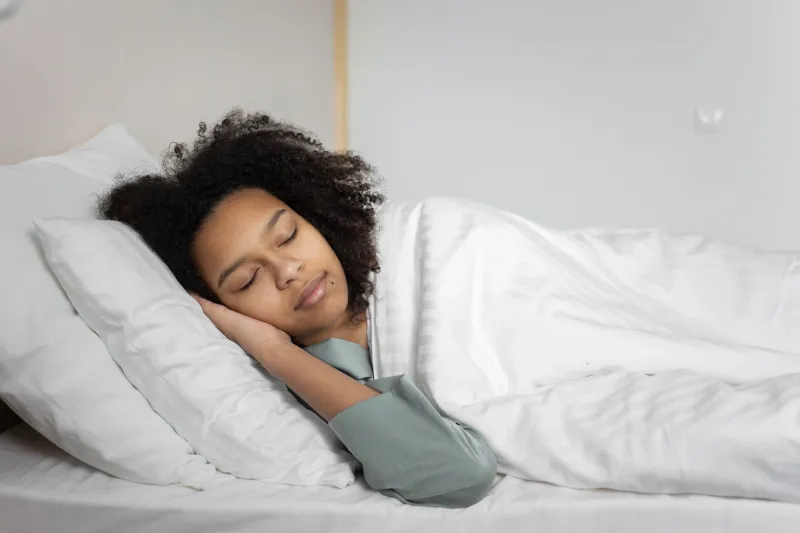
The tension between indulgence and wellness is, in many ways, a false one. Your body doesn't experience them as opposites. When you slide into cool, smooth silk sheets at the end of a long day, your nervous system doesn't file that under "frivolous pleasure." It files it under safe. Calm. Recover now.
And maybe that's the real paradox worth sitting with: we've spent so long treating comfort as a guilty pleasure that we forgot it's also — when it's intentional, when it's chosen with care — one of the most practical things we can do for ourselves.
So the next time your brain tells you silk is a splurge? You have full permission to politely disagree.