Meet the American Silk Farmers Who Are Quietly Changing the Way We Think About Ethical Wellness
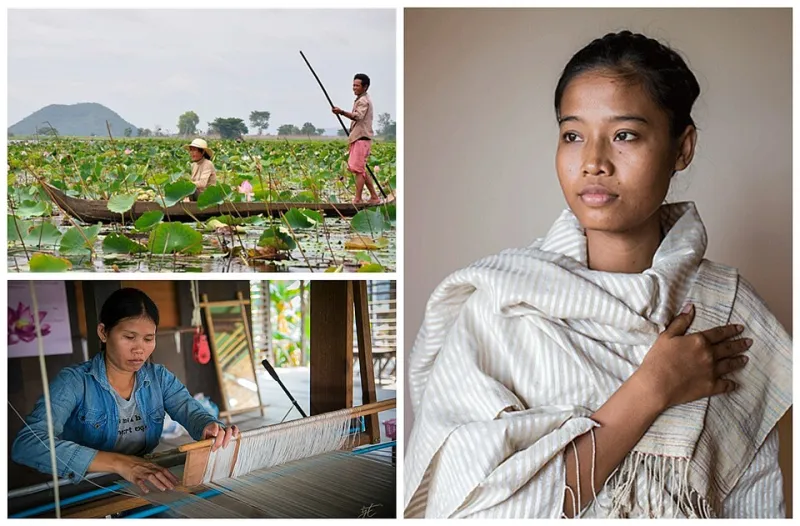
Photo: Visit Angkor, CC BY-SA 4.0, via Wikimedia Commons
The Hidden Story Behind Your Silk
When most Americans pick up a silk product, they don't think much about where it came from. Silk is silk, right? Smooth, luxurious, timeless. But behind that soft sheen is a supply chain that varies wildly — from tightly regulated, small-scale farms with genuine commitments to sustainability, to large industrial operations where environmental and animal welfare standards are, let's say, an afterthought.
The good news? There's a quiet revolution happening on American soil. A growing cohort of domestic silk producers is proving that you don't have to choose between quality and conscience. And as consumers become more intentional about what they bring into their homes and onto their bodies, these farmers are finding their moment.
This is a story about those people — and why what they're doing matters to your wellness in ways that go far beyond thread count.
Why Domestic Silk Production Is Different
The vast majority of the world's silk comes from China and India, where sericulture (the cultivation of silkworms) has operated at industrial scale for centuries. That's not inherently a problem, but scale tends to invite shortcuts. Mass-market silk production frequently involves heavy pesticide use on mulberry crops, inconsistent labor practices, and processing methods that rely on chemical treatments to achieve uniformity and volume.
American silk farmers operate in a fundamentally different context. Domestic production is small by necessity — the US doesn't have the climate or infrastructure for industrial-scale sericulture — which means every farm is, almost by definition, a craft operation. These producers tend to be deeply invested in their practices, not just because it's good marketing, but because they're often doing this out of genuine passion for the craft and the land.
Many American silk farmers grow their own mulberry trees — the sole food source for Bombyx mori silkworms — without synthetic pesticides, creating a closed-loop system where the health of the soil directly affects the quality of the silk. It's slow, labor-intensive work. And it produces something genuinely different from what you'll find mass-produced overseas.
Profiles in American Sericulture
Take operations like the handful of small farms scattered across the Southeast and Pacific Northwest that have been quietly building sustainable silk programs over the past decade. While naming individual farms varies by region and availability, the pattern is consistent: these are often family-run operations or small cooperatives where the farmers themselves can tell you the life cycle of every silkworm batch, the source of their mulberry cuttings, and exactly how their cocoons are processed.
Some of the most innovative domestic producers are experimenting with peace silk (also called ahimsa silk), a method that allows the moth to emerge from the cocoon naturally before the fiber is harvested, rather than the conventional practice of boiling cocoons with the pupa still inside. It's a lower-yield process — the emerged moth breaks the continuous fiber thread — but it reflects a commitment to animal welfare that resonates deeply with ethically-minded consumers.
Others are focused on regenerative agriculture principles, planting mulberry trees as part of broader reforestation and soil health initiatives. Mulberry trees are remarkably low-maintenance, require minimal water compared to conventional crops, and their leaves sequester carbon. A silk farm built around healthy mulberry cultivation is, in many ways, a carbon-positive enterprise. That's a story worth telling.
What "Ethical Consumption" Actually Means in Practice
Here's where I want to be honest with you, because the phrase "ethical consumption" gets thrown around so casually that it's starting to lose meaning. Buying a sustainably-produced silk pillowcase isn't going to save the planet on its own. But the choices we make about where our money goes do shape markets over time — and right now, the market for transparent, domestically-produced natural fibers needs consumer support to grow.
When you choose a silk product from a US-based producer committed to sustainable practices, you're doing a few things at once. You're supporting American agricultural livelihoods. You're reducing the carbon footprint associated with international shipping and processing. You're opting out of supply chains that may involve environmental harm or labor exploitation. And you're investing in a product whose origins you can actually trace.
That traceability piece is huge. The wellness world talks a lot about knowing what's in your food, your skincare, your supplements. The same logic applies to the fabrics you sleep in every night. Knowing that your silk was raised on pesticide-free mulberry, processed without harsh chemical baths, and produced by people who genuinely care about the outcome — that's not a small thing.
How to Identify and Support Sustainable Silk Brands
So how do you actually find the good stuff? A few things to look for:
Ask about origin transparency. Any brand serious about sustainability should be able to tell you where their silk comes from. Vague answers like "ethically sourced" without specifics are a red flag.
Look for third-party certifications. OEKO-TEX Standard 100 confirms the final product is free from harmful substances. The Global Organic Textile Standard (GOTS) is the gold standard for organic fiber processing. These aren't easy certifications to earn, which is exactly why they matter.
Seek out brands that talk about their farmers. The best sustainable silk brands have relationships with their producers — and they're proud to show it. If a brand's website has nothing to say about where their silk comes from, that silence is telling.
Consider domestic-first. US-produced silk may come at a premium, but you're paying for a level of transparency and accountability that's genuinely hard to achieve at international industrial scale.
At Sylk USA, our commitment to pure silk isn't just about the end product. It's about honoring the entire chain of care that brings that product to you — from soil to silkworm to the pillowcase on your bed.
Wellness That Extends Beyond Yourself
There's a version of wellness that's purely personal — better sleep, healthier skin, more energy. And that version is completely valid. But there's a deeper version that recognizes our individual health is inseparable from the health of the systems around us: the land, the communities, the supply chains we participate in.
The American silk farmers building sustainable operations right now are doing something quietly radical. They're proving that luxury and ethics aren't mutually exclusive, that beautiful things can be made with care for the world they come from. Supporting them is, in the truest sense, a wellness choice — one that ripples outward in ways that matter.
Pure silk. Pure wellness. The story of where it comes from is part of what makes it pure.