Why Your Pillowcase Might Be Sabotaging Your Skin (And What to Do About It)
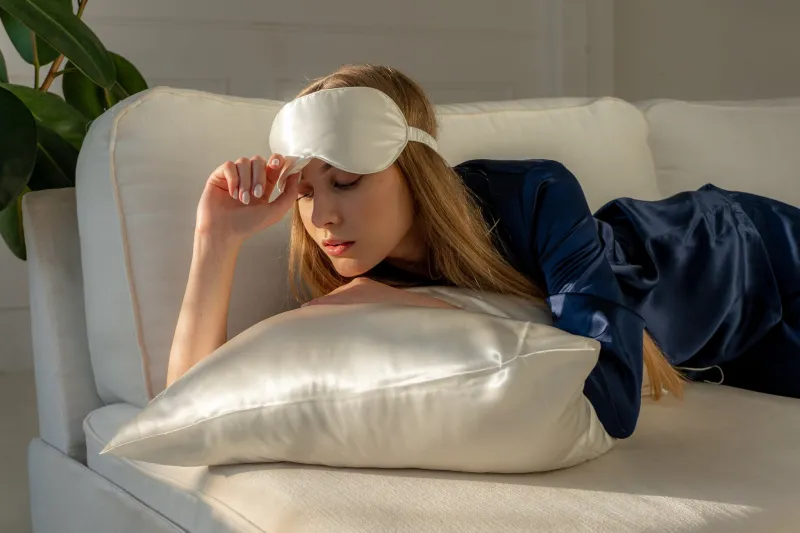
Photo: woman sleeping peacefully on silk pillowcase close up skin, via silkclosetthelabel.com
The Thing Nobody Tells You About Your Bedtime Routine
You probably spend a decent chunk of money on serums, moisturizers, and hair masks. You drink your water, take your vitamins, maybe even do a little facial massage before bed. But then you lay your head down on a rough cotton pillowcase and, honestly? A lot of that effort gets undone overnight.
It sounds dramatic, but the research backs it up. The average person shifts positions somewhere between 40 and 60 times per night. Every single one of those movements creates friction between your skin and whatever fabric you're sleeping on. Over months and years, that repeated mechanical stress adds up — and your complexion, your hair, and even your sleep quality can take the hit.
This is where silk comes in. And no, this isn't just a luxury trend for people who monogram their bathrobes. There's genuine, peer-reviewed science here worth unpacking.
What the Research Actually Says
Let's start with skin. Dermatologists have long understood that friction is one of the sneakier contributors to skin aging. A 2019 study published in the Journal of Cosmetic Dermatology found that repeated mechanical friction accelerates the breakdown of collagen and elastin — the structural proteins responsible for keeping skin firm and smooth. Cotton, while breathable, has a relatively rough fiber structure that drags against delicate facial skin throughout the night.
Silk, by contrast, has a naturally smooth protein structure made primarily of fibroin. Its surface creates significantly less friction, which means your skin can glide rather than tug as you move. Dermatologist Dr. Hadley King, frequently quoted in US wellness media, has noted that patients with sensitive skin, rosacea, and acne-prone complexions often report reduced irritation after switching to silk bedding. Less friction means less inflammation, and less inflammation is almost always a win for your skin.
For hair, the benefits are equally well-documented. Cotton pillowcases are notoriously absorbent — they pull moisture from your hair shaft and create the kind of surface roughness that leads to tangles, split ends, and breakage. A study from the International Journal of Trichology highlighted how mechanical stress during sleep is a meaningful but underappreciated contributor to hair shaft damage over time. Silk's low-friction surface lets strands move freely, preserving both moisture and structural integrity. If you've ever woken up with a bird's nest situation on your head, you already know this in your bones.
But Does It Actually Improve Sleep?
Here's where things get interesting. Beyond skin and hair, there's a growing conversation among sleep specialists about how fabric temperature regulation affects sleep quality. Silk is a naturally thermoregulating material — it adjusts to your body temperature rather than trapping heat the way synthetic fabrics do. For hot sleepers (and Americans broadly report sleep disruption related to overheating), this can make a real difference in how long you stay in deeper sleep stages.
Sleep specialist Dr. Chris Winter, author of The Sleep Solution, has spoken about the role of thermal comfort in sleep architecture, noting that even small environmental changes can shift how restorative your sleep actually is. A cooler, more comfortable sleep surface supports the natural drop in core body temperature that signals deep, restorative sleep. Silk's breathability and temperature-balancing properties put it ahead of most conventional bedding materials in this regard.
Debunking the Myths
Okay, let's address the skeptics — because there are a few things floating around about silk pillowcases that deserve a reality check.
Myth #1: It's just a placebo. The friction reduction is measurable and real. This isn't wellness woo — it's basic textile science applied to dermatology.
Myth #2: Any satin will do. This is a big one. Polyester satin looks similar but behaves completely differently. It doesn't breathe, it traps heat, and it lacks silk's natural protein structure. If you're buying a $12 "silk" pillowcase, you're almost certainly getting polyester satin. Always check the momme weight and fiber content.
Myth #3: You have to wash it by hand forever. High-quality silk can absolutely be machine-washed on a delicate cycle with a gentle, pH-neutral detergent. It just needs a little more care than your average cotton sheet.
How to Choose a Silk Pillowcase That Actually Works
Not all silk is created equal, and the market is flooded with products making claims they can't back up. Here's what to actually look for:
- Momme weight: This measures silk density. For pillowcases, you want at least 19 momme — anything lower is too lightweight and won't hold up. 22 momme is the sweet spot for durability and softness.
- Mulberry silk: This is the gold standard. Mulberry silkworms produce the most consistent, finest fibers. It's what you want next to your skin.
- OEKO-TEX certification: This certification confirms the fabric has been tested for harmful chemicals. It's a meaningful indicator of quality and safety.
- Envelope or zipper closure: A well-constructed pillowcase stays put through the night. Cheap versions bunch and shift, defeating the purpose.
At Sylk USA, these aren't just talking points — they're the baseline. Pure silk isn't a marketing word for us; it's the whole foundation.
Small Switches, Real Results
Wellness doesn't always require a complete lifestyle overhaul. Sometimes it's a single, intentional swap that compounds over time. Think about it: you're already sleeping. You're already spending those hours in contact with a pillowcase. The question is just whether that time is working for you or quietly working against you.
A silk pillowcase won't replace your SPF or your hydration routine. But it will stop undoing them every single night. For health-conscious Americans who are already thoughtful about what they put on their skin, it makes sense to be equally thoughtful about what their skin is resting on.
Your nighttime ritual deserves a fabric that's as intentional as everything else you do. That's not indulgence — that's just smart wellness.